06: Some thoughts on past posts, or what are we doing here?
For the past year, I've been letting my curiosity drive my research. At least, I tried to. It took me a while to get good at it. I've been on a makeshift sabbatical, a word which implies exploration. I started, however, with a clear idea of where I might end up and how I might get there. A productive urge told me that the research I conducted had to relevant to some longer-term goals or had to coalesce in neatly packaged insights. The same urge kept delaying any sharing of my findings, as they'd be better presented next week. And again the next. Hence, months of silence in 2022, despite my best intentions. Letting that go was a process, but one that expanded my horizons.
I have arrived, not so much to insights, as to the places that I'd like to explore productively for the next few years. An interest in communal responses to climate change led me on an extended trip to New Orleans and Southwest Louisiana. The efforts of that community continue to fascinate me. Expanding wireless coverage – an admittedly odd hobby/side hustle – has led me to a raft of community investment challenges in my home city of South Bend and others like it. I've explored the role of faith and mental wellbeing in community health, in particular, the ways that it can empower or undercut communal action. I've explored internet communities too, and have been surprised at how little I knew of them, despite the excessive amounts of time we all spend online.
If one insight has emerged from all this, it's that we're at an interesting time for communal action and its most frequent manifestation, cooperatives. For the past decade, in most developed markets, capital has been readily available to those that want or need it. This has not been the case for many cities and communities mentioned above. In fact the opposite, overallocation of capital to more liquid opportunities has created price and capability imbalances between geographies and industries. Instability and overreliance on large markets have been the results for underinvested communities.
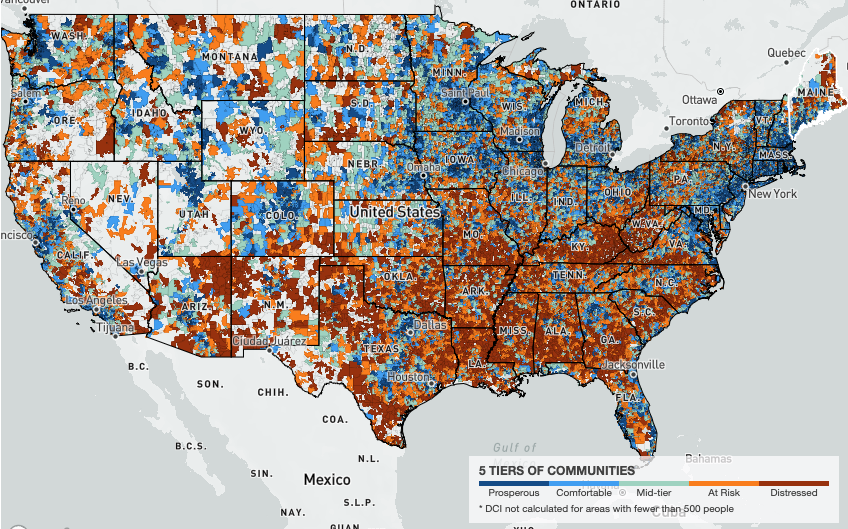
Anyone living in maroon or terra cotta knows how brutal it is to be called "distressed". Those same people can also reel off four or five potential productive investments were capital simply theirs to invest. But it's not. Most allocators look at these communities, and see no investible projects. Depending on the ideological alignment, it's viewed as a moral failure of capitalism or a structural failure of communities unprepared for capital.
This is not new. The chart, the narrative, the tension are, in many ways, just a natural progression of market cycles. We frequently forget the ending. Top-down allocation reaches the limits of scalable investment opportunities. Capital overinvests in opportunities it understands creating imbalances. Our imaginations (and popular history) jump to radical outcomes like revolt or government reallocation. Just as often, however, communities disheartened by a lack of investment advance their own priorities through cycles of grassroots capital formation.
Cooperatives and credit unions arise in response to community need. They almost always intend to endure alongside (or in place of) their scalable, centralized competitors. They almost always fail. A priming of the pump, they show centralized competition a market for capital where none existed before. Investment ensues, and lower prices are the compensation for a lost sense of community and meaning.
Communal action in markets remains sustainable only if supply and demand are restructured to the point that consumers gain access to wholesale pricing. Most cooperative structures never quite push so far. The operate with roughly the same structures as their centralized competitors, and rely on non-profit status, solidarity, or volunteerism to deliver ephemeral, incremental price reductions. While such strategies work in peak inflationary periods, they struggle to deliver value over extended periods. The co-ops fold and the cycle begins again.
It feels like that might be changing. Technology is making it easier to reorganize supply and demand, and do so in a way that's communal by default. Open source software for example can deliver high quality product at a fraction of the total investment. Digital money means that it's never been easier for a community to capitalize its own financial institutions with whatever resources might be at hand and start investing in themselves. Cooperatives are evolving to deliver sustainably affordable goods and services to their community, so the cooperative economy might be larger than we think.
Who knows if this will exist alongside or in place of a more traditional, top-down economy. Who knows if it will exist at all. It's easily the most interesting set of questions I could find in a year, so it's where I'll be. Expect many of the posts to follow to examine the history of cooperative structures, explore the moral and financial realities of capital imbalances across communities, and unpack the policies that have brought us to today. There will be a lot of tangents, but that's increasingly our general direction.
If you're thinking through the same things, I'd love to talk.